



In this blinded case study from Porterhouse Insights, explore how we mapped the IgAN patient pathway across seven European markets.
Why the pathway comes first
Before a new treatment can find its place, you need a clear view of the pathway it’s entering. Who do patients see first? How are they diagnosed? And who makes the treatment decisions once they are?
In IgA nephropathy (IgAN), those questions carry more weight as new options reach the market and treatment algorithms shift. A forecast built on assumptions about the pathway can look sound on paper and still miss how patients actually move through care. This blinded case study shows how we helped one client answer those questions for their asset across seven European markets.
The challenge
Our client needed a full understanding of the IgAN management pathway a comprehensive understanding of their asset’s opportunity within it. To get there, the research had to:
- Map the pathway from diagnosis to ongoing management
- Understand current treatment algorithms
- Understand different patient profiles
- Explore reactions to the target product profile (TPP) and where it would fit in the treatment pathway
The project also included a patient component, which sits outside this case study.
Our approach
We combined a quantitative survey with qualitative follow-up across seven markets: the UK, France, Germany, Italy, Spain, the Netherlands and Sweden.
In total, 172 nephrologists completed the questionnaire. We then held 45 follow-up interviews with survey respondents to explore the reasoning behind their answers. Alongside this, we collected 344 IgAN patient record forms, giving a view of real cases as well as reported practice.
Bringing the two strands together meant we could test what clinicians told us against the patients they were actually managing.
What we found
How patients move through the pathway
- Presentation: Over three-quarters of patients presented acutely, for example with haematuria. The rest presented with non-specific signs such as hypertension.
- Diagnosis: all patients were diagnosed by biopsy, carried out by a nephrologist.
- Treatment: Most patients (~two-thirds) of patients were managed by a nephrologist.
The time taken to reach a nephrologist ranged from two weeks to a year.
Where the asset would fit
ACE inhibitors or ARBs, with or without SGLT-2 inhibitors, formed the foundation across all lines of therapy.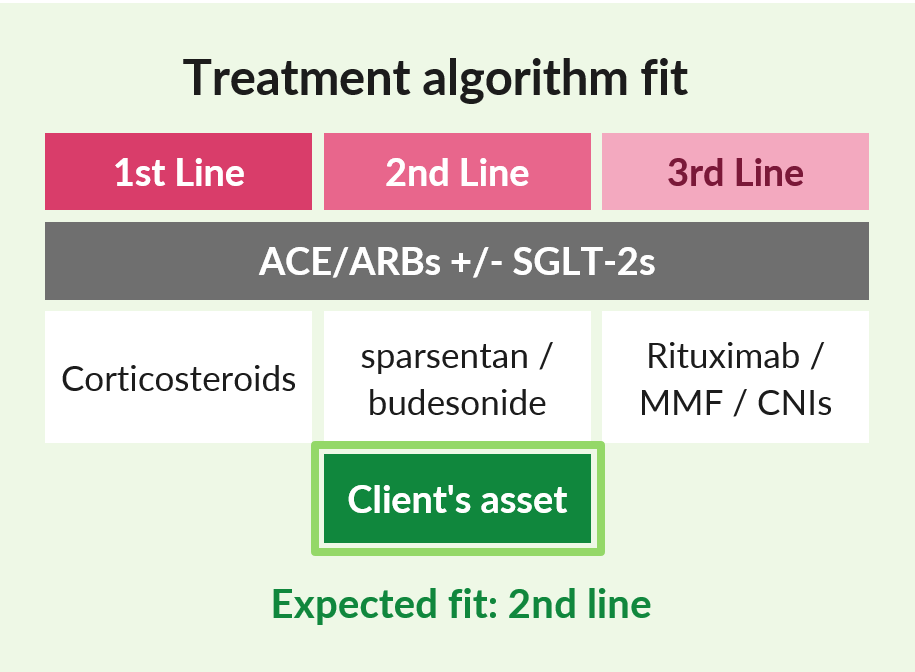
Key findings
- Expected uptake was high, in line with positive feedback on the profile.
- Uptake was limited by indication, as HCPs were eager to prescribe but the indication set a ceiling on eligible patients.
- The pathway already works efficiently. The client’s realistic levers are biopsy frequency and patient uptake.
What it meant for the client
By combining interview and survey insights, the client gained a full picture of the IgAN landscape and a clear view of their asset’s place within it. They could see where the asset would sit, how it was likely to perform against the category, and which parts of the pathway they could realistically influence.
That focus matters. Knowing the pathway already works well steered effort towards the levers that would make a difference.
Planning your next project?
If you have a TPP to test or a pathway to map ahead of launch, our team can help you build the evidence behind the decision. Contact us at info@porterhouseinsights.com.
 Group