


For someone living with diabetes, managing blood glucose levels can be a constant minefield. Everyday choices, such as deciding what to eat or planning physical activity perpetually influence glucose levels, making regular monitoring and treatment adjustments critical. But what if technology could help take some of that responsibility away?
What is diabetes?
Diabetes is a chronic condition characterised by elevated blood glucose levels, which occur when the body either does not produce enough insulin or cannot use it effectively. The two main forms are type 1 diabetes, an autoimmune condition in which the insulin-producing cells of the pancreas are destroyed, and type 2 diabetes, which is characterised by insulin resistance and a progressive decline in insulin production [1].
Risk factors for diabetes
The risk factors for diabetes vary depending on the type. Type 1 diabetes is an autoimmune condition with genetic and environmental factors thought to contribute to its development, although the exact causes are not fully understood [2].
In contrast, several risk factors for type 2 diabetes have been identified, including: [3,4]
- Family history of type 2 diabetes
- Increasing age
- Overweight or obesity
- Physical inactivity
- Certain ethnic backgrounds, including South Asian, Black African and Black Caribbean heritage
- A history of gestational diabetes
While some of these factors cannot be changed, others may be addressed through lifestyle changes, helping to reduce the risk of developing type 2 diabetes.
Recognising the key symptoms
Common symptoms include increased thirst, frequent urination, fatigue and unexplained weight loss, although symptoms can develop gradually or go unnoticed, particularly in type 2 diabetes [5,6]. If left poorly controlled, persistently elevated blood glucose levels can increase the risk of serious long-term complications, including cardiovascular disease, kidney damage, vision loss and nerve damage [5,6].
Improving diabetes management
With approximately 830 million people living with diabetes worldwide, improving how the condition is managed remains a global healthcare priority [7]. It’s no surprise then that the disease remains a major focus for medical research, particularly in the development of effective disease management tools. Advances in continuous glucose monitoring (CGM), automated insulin delivery (AID) and artificial intelligence (AI) are changing the way people monitor and manage their glucose levels, offering opportunities to reduce the burden of daily care [8-10].
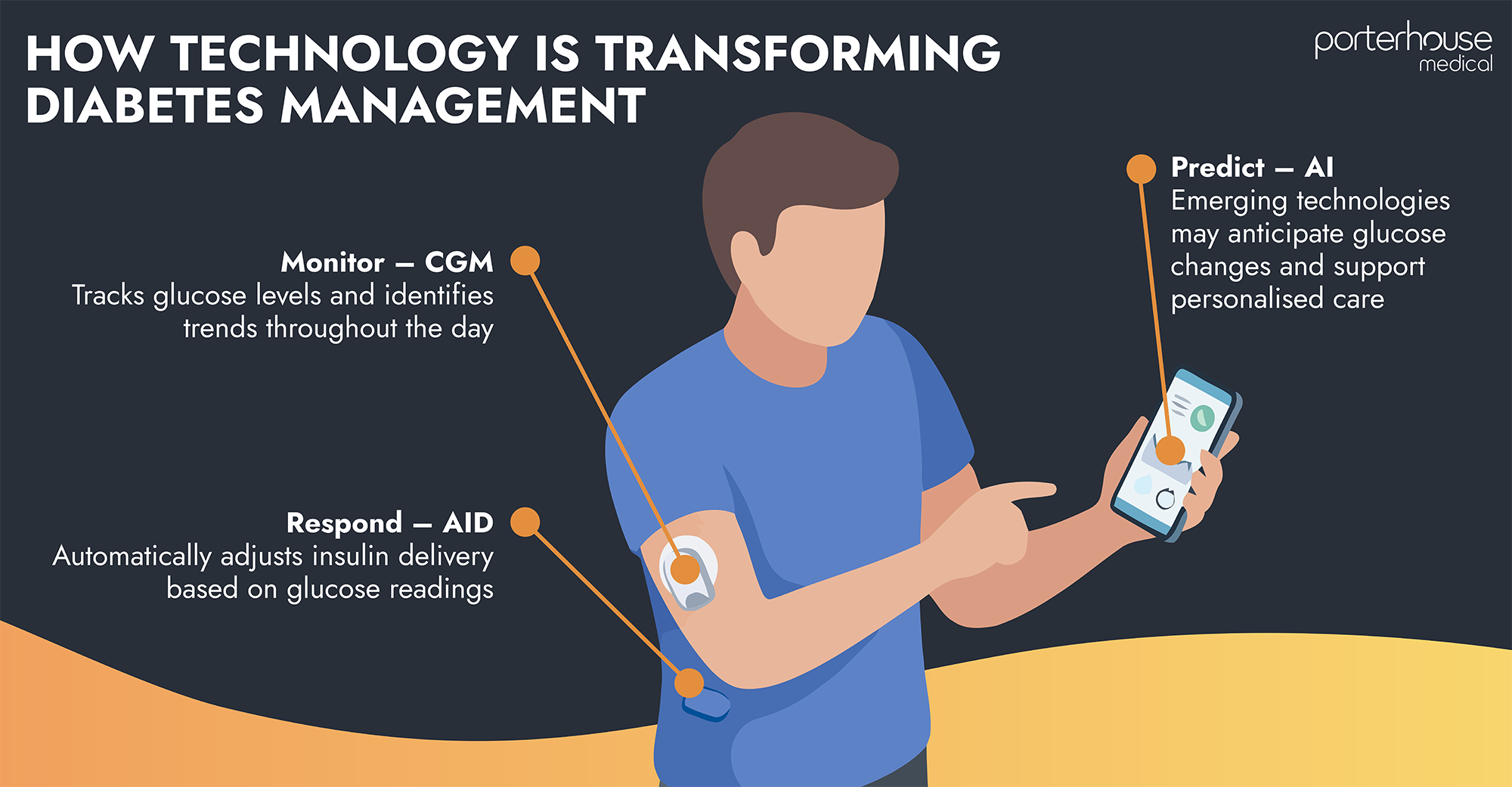
As these technologies are becoming more and more sophisticated, they’re able to provide personalised diabetes management beyond just simply monitoring glucose levels towards predicting changes and responding to them in real time [8-10].
Continuous glucose monitoring
Traditionally, blood glucose monitoring has involved finger-prick testing, which provides a measurement of glucose levels at a snapshot in time. Although useful, this approach does not capture continuous changes in glucose levels in response to internal or environmental changes.
CGM provides more detailed information by measuring glucose concentrations in the interstitial fluid at regular intervals using a small sensor inserted beneath the skin. These measurements are transmitted to a compatible device, allowing users to track glucose levels and identify patterns throughout the day. Importantly, many CGM systems also provide alerts when glucose levels fall outside a predefined range, helping users identify and respond to potential episodes of hypoglycaemia or hyperglycaemia [9].
Automated insulin delivery: Reducing the burden of treatment
While CGM provides valuable information, it still falls on users who require insulin to make regular dosing decisions about their treatment [9].
New automated delivery technology overcomes this hurdle by combining CGM with an insulin pump and a control algorithm that uses glucose measurements to automatically adjust insulin delivery.9 This reduces the need for frequent manual adjustment, improving glucose control and potentially giving users peace of mind [9].
Evidence supporting their use continues to grow. A 2025 randomised controlled trial involving 319 adults with insulin-treated type 2 diabetes assessed the effectiveness of AID compared with conventional insulin delivery supported by CGM. After 13 weeks, glycated haemoglobin (HbA1c) decreased by 0.9 percentage points in the AID group, compared with 0.3 percentage points in the control group. Participants using AID also experienced a greater improvement in time-in-range (TIR) which refers to the percentage of time glucose levels remain within a predefined target range [11].
These findings are particularly relevant as AID systems have historically been used mainly in type 1 diabetes. Their expanding use in type 2 diabetes could provide an additional treatment option for people who require insulin [9,11].
Evolving personalised care with artificial intelligence
AI is another area of growing interest in diabetes management, particularly in the development of systems that can predict glucose changes more accurately and support treatment decisions. For instance, machine learning could help support more personalised insulin delivery by incorporating additional information such as physical activity and individual glucose patterns [10].
A randomised clinical trial investigated an AI-augmented AID system that combined glucose prediction algorithms with physical activity data collected from wearable fitness sensors in people with type 1 diabetes. The system automatically adjusted insulin delivery in response to activity, achieving significantly lower mean glucose levels in the two hours following the start of exercise compared with an alternative exercise-aware system. These findings highlight the potential for combining predictive algorithms with additional physiological data to support more personalised glucose management [12].
Challenges and future directions
Despite the benefits of diabetes technologies, several challenges remain. Access to devices can vary depending on cost, healthcare provision and eligibility criteria, while technical issues, including sensor inaccuracies, connectivity problems and frequent alerts, can affect their usability [8].
A 2026 joint position statement from the American Diabetes Association (ADA) and European Association for the Study of Diabetes (EASD) highlighted the importance of individualising diabetes technology according to patients’ clinical needs, preferences and circumstances [8].
As continuous glucose monitoring and automated insulin delivery systems continue to improve glucose management, advances in AI and predictive technologies could offer further opportunities for personalised care. However, ensuring these technologies are accessible, reliable and appropriate for individual needs will be essential to improving outcomes and reducing the day-to-day burden of living with diabetes.
References
- American Diabetes Association Professional Practice Committee for Diabetes. Diabetes Care 2026; 49 (Suppl 1): S27–S49.
- Diabetes UK. What causes type 1 diabetes? Available at: https://www.diabetes.org.uk/about-diabetes/type-1-diabetes/causes. Accessed November 2026.
- Diabetes UK. Type 2 diabetes risk factors. Available at: https://www.diabetes.org.uk/about-diabetes/type-2-diabetes/diabetes-risk-factors. Accessed November 2026.
- Centers for Disease Control and Prevention. Diabetes risk factors. Available at: https://www.cdc.gov/diabetes/risk-factors/. Accessed November 2026.
- World Health Organization. Diabetes: Questions and answers. Available at: https://www.who.int/news-room/questions-and-answers/item/diabetes. Accessed November 2026.
- Diabetes UK. Diabetes signs and symptoms. Available at: https://www.diabetes.org.uk/about-diabetes/symptoms. Accessed November 2026.
- World Health Organization. Diabetes. Available at: https://www.who.int/news-room/fact-sheets/detail/diabetes. Accessed November 2026.
- Bruttomesso D et al. Diabetes Care 2026; 49 (6): 916–930.
- American Diabetes Association Professional Practice Committee for Diabetes. Diabetes Care 2026; 49 (Suppl 1): S150–S165.
- Dubský M et al. Diabetes Obes Metab 2026; 28 (6): 4587–4601.
- Kudva YC et al. N Engl J Med 2025; 392: 1801–1812.
12. Jacobs PG et al. Lancet Digit Health 2023; 5 (9): e607–e617.
 Group